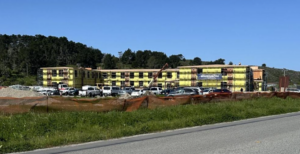
For the families behind the Big Wave project, the building that is slowly rising along Airport Road north of Pillar Point Harbor is more than just a structure. It is a community’s home taking shape. And for the Coastside, it is an opportunity to watch a new neighborhood form.
It’s not often that the Coastside gets a new neighborhood. But this spring, the Coastside will welcome a new residential community nearly 25 years in the making—one that many of its future residents and their loved ones have been waiting years, and in some cases decades, to join.
Big Wave will be a 50,000-square-foot residential and community campus designed to serve adults with intellectual and developmental disabilities. The U-shaped building will include 40 apartments. The project is designed not only for housing but also as a place where residents can live independently and connect with a community.
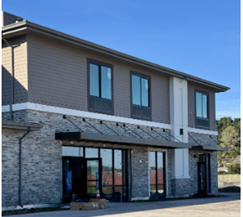
The exterior of the Big Wave complex as it prepares to open this spring.
Courtesy Big Wave Project
While the story of Big Wave may have started with a generous donation by two families of land near the ocean at Pillar Point Harbor, it quickly became a decades-long process of permitting, planning and revised timelines. For the families behind the project, that timeline began not with construction, but with the moment their children approached adulthood, and the services and community they relied on began to fall away as they aged out of school district services at age 22.
“They lose their services, they lose their education, and most importantly, they lose their community,” said Julie Shenkman, a parent of one of the future residents and a member of the project’s board. “And that’s something they can’t rebuild on their own.” The result, Shenkman said, is that many adults with intellectual and developmental disabilities face isolation, depression, long waiting lists for services, and limited opportunities for work, social connection and daily structure.
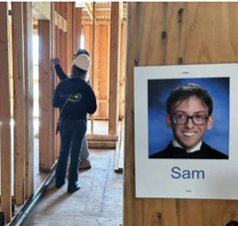
Parents write messages to their children on the building’s beams during the topping-off ceremony.
Courtesy Big Wave Project
Big Wave was designed to respond to that moment—not simply by providing housing, but by creating a place where adults with disabilities can live independently, build relationships, develop skills and remain connected to the broader community. But it did not start that way. At first, the focus was on building a campus. Over time, the idea expanded into building a community, Shenkman said.
“This isn’t just a building,” Shenkman said. “It’s about dignity, independence, and connection. It’s about giving our kids the chance to have a real life in a real community.”
As planning progressed, Shenkman said the scope of the project began to shift. What started as a plan for housing expanded into a vision for building a community—one designed around daily life, social connection and shared space.
That shift is visible in the design of the campus itself. In addition to 40 apartments, the building includes a large dining room and commercial kitchen, recreation and fitness spaces, a game room and a 10,000-square-foot enclosed courtyard designed for gatherings, outdoor movies and community events.
Parents, siblings, caregivers and volunteers have formed their own network through years of planning meetings, board service, committee work and shared decision-making. Families who once navigated the challenges of disability primarily on their own now find themselves connected to others on similar paths.
“You really walk a different path as a special-needs parent,” Shenkman said. “It’s really different. You don’t do the same things other families do, and you don’t always have the same support.”
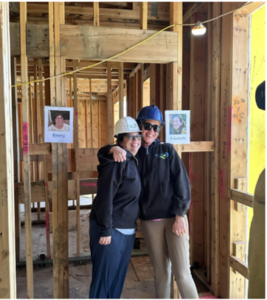
Families and future residents pose for photos during the building’s topping-off ceremony.
Courtesy Big Wave Project
Local attorneys, nonprofit leaders, construction professionals, and retired healthcare workers have donated their expertise. The Half Moon Bay City Council came to tour the site, and organizations ranging from local groups to Google have stopped by with volunteer teams ready to help and connect their work with the project.
Organizers want the campus itself to serve as a bridge between residents and the broader community. In addition to shared spaces for residents, the building includes several commercial spaces intended for organizations or businesses that can offer career support services, volunteer opportunities or programming connected to the mission.
Even before the building opens, future residents and their families already meet quarterly to plan together. For Joey Sayles, one of the future residents and the group’s oldest member at 50, those meetings marked the beginning of something he has waited a long time to see.
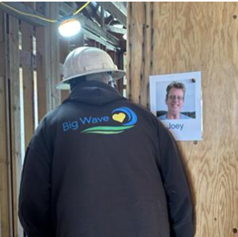
Joey Sayles looks into his future room during the topping-off ceremony.
Courtesy Big Wave Project
“It’s been really good,” Sayles said of watching the community take shape. “It’s been a long time for it to come.” Sayles has been part of the Big Wave community since long before construction of the new building began, regularly helping out at the Big Wave farm. He entered a 36-pound pumpkin he grew there in last year’s Pumpkin Weigh-Off on behalf of Big Wave.
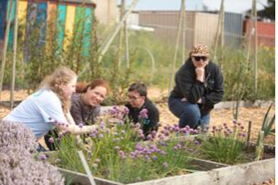
The farm on the Big Wave property serves as a gathering place for residents and the community.
Courtesy Big Wave Project
As the oldest of the future residents, he said he sometimes finds himself in a mentor role for younger members of the group, offering familiarity, stability and a sense of continuity as the community prepares to move in together. “I’m looking forward to seeing it really happening,” Sayles said. “It took a lot of people working behind the scenes. That team worked so hard.”
Earlier this year, families and future residents were invited inside the unfinished building for a “topping off” ceremony, where they saw their apartments for the first time and wrote messages and names on the walls before the drywall went up.
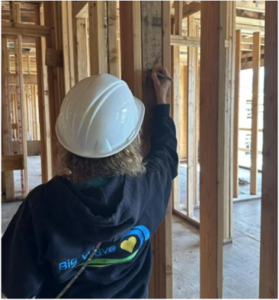
Parents write messages to their children on the building’s beams during the topping-off ceremony.
Courtesy Big Wave Project
“It’s a tradition in building,” Shenkman said. “When you place the highest beam, you stop and you thank everyone who’s been part of the project. But for us, it became something much more personal.”
Families and residents were invited to walk through the structure while it was still open and unfinished. Some brought photographs, and many wrote notes directly onto the framing—messages to themselves, to their loved ones and to the future residents who will soon call the building home.
For many parents, it was a visible sign that the project they had worked on for decades was finally becoming real, and that their sons and daughters were preparing to take a step toward independence.
“We wanted to give the building some heart and soul. There were a lot of tears,” Shenkman said. “It’s like any parent becoming an empty nester, except this is the first time for most of them that their kids are moving out.”